About the guest
Nanak Naam
The organisation SathPaal founded to share Guru Nanak’s teachings.
Visit Nanak Naam ↗Wisdom · Season 2 · Episode 1
SathPaal Singh
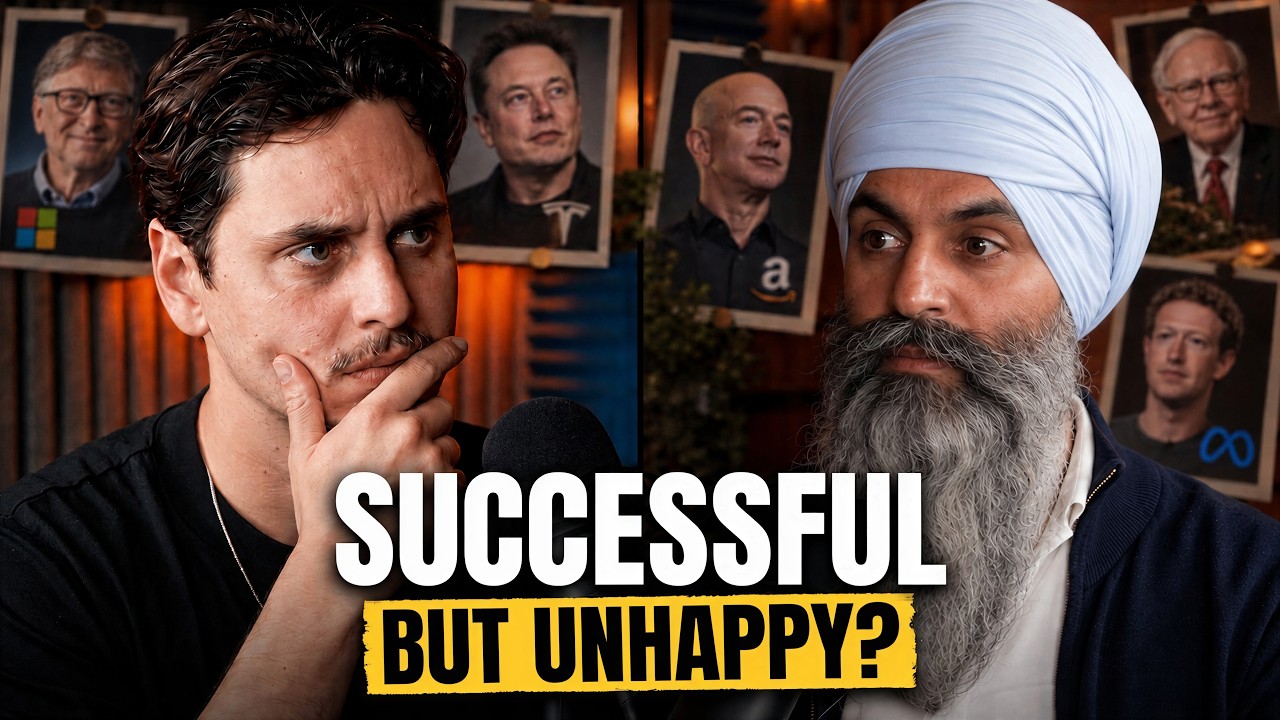
Watch or listen
Watch the video or listen without leaving the browser.
The conversation
I kept asking SathPaal Singh how to let go. At one point, he asked whether I'd be okay if a power cut meant we couldn't finish the episode.
Fair question to put to the bloke making the podcast.
For the first episode of the Healthy, Wealthy & Wise relaunch, I sat down with SathPaal, a Sikh spiritual teacher and founder of Nanak Naam. He grew up in India before moving to the UK at eight. Years into a successful IT career, he began combining his tech skills with his interest in spirituality, sharing the teachings he'd found useful through an online channel.
We spoke about Guru Nanak's teachings, ambition, marriage and loss. I kept coming back to one question: how do you build something you care about while being content with the life you have?
SathPaal spoke about setting targets for subscribers and views in his own work. He recognised a habit in himself: each goal became another condition he had to meet before he could be happy.
Get the subscribers. Get the promotion. Get into the relationship. Then you can feel good.
His concern is that we get used to waiting. When the thing arrives, there's another thing to chase. In his view, being content with the present takes practice too.
I asked whether you can be happy and successful. His answer was yes. He encouraged learning to be okay even if the success you're working towards doesn't arrive.
A useful place to start is your own “if only” list. Pick one thing you're chasing and ask how much of your happiness you've made conditional on getting it. You can keep working towards the goal while questioning that condition.
The conversation about expectations needed a bit of pushing.
SathPaal gave an example: we agree to meet at one, he arrives at three, and I'm frustrated. If I'd invited him to come whenever he liked, the same arrival time could feel fine.
I asked how anything would get done without expectations, boundaries and people keeping their word.
He agreed that agreements matter. Respecting someone's time matters. If he's late and doesn't call, that's his responsibility.
He draws a distinction between making an agreement and continuing to hold on to how things should have happened once reality has changed. You still have to decide what to do about the missed agreement. His point is that replaying your frustration adds something you then have to live with.
Make the expectation clear and keep your part of it. When something goes wrong, deal with what's happened. Acceptance and accountability can exist in the same conversation.
SathPaal was open about getting frustrated. He has a wife, children, a home and a business. There are plenty of opportunities.
The question he asks himself is: “SathPaal, are you enjoying this right now?”
He says it helps him notice the story he's telling himself about an event: why did they do that, why isn't this happening, why is life unfair?
The event and that running commentary are two things he can examine. For him, noticing the commentary helps him let go of it.
It's a question you can try when you catch yourself replaying an annoyance. There's still a late person, a changed plan or a problem to solve. You can also look at what you're adding to it in your own head.
We also spoke about the miscarriage SathPaal and his wife experienced.
He described acceptance as central to their spiritual practice and said it helped them cope with that loss. He also said it was a difficult time and that they experienced the emotions you'd expect.
This is their account of what helped them. It gives nobody a deadline for grieving or an obligation to experience loss the same way.
When I asked what supported him, SathPaal named spiritual teachings and meditation. He sees the two as connected: understanding the mind alongside spending time sitting with it.
Earlier, I'd asked about religious rituals, including questions that had come up while I was re-exploring my Christian faith.
SathPaal suggested understanding what a practice is meant to teach you, then choosing rituals that support that understanding. He pointed to anger and desire as harder things to work with than completing an outward ritual.
That gives you something concrete to ask of a practice: what am I learning about how I respond to people? If you're looking for a teacher, he also warned against teachings that encourage contempt for others or make your group feel superior.
He acknowledged the conditions people need for this work too, including safety and financial stability. Someone in immediate danger needs help with that situation.
His recommendation was to combine guidance with meditation. For anyone keen to explore that, the full conversation gives you his reasoning, along with the questions I kept asking when “just let go” needed a bit more explaining.
Keep working towards your goals while asking how much of your happiness you have made conditional on reaching them.
Make clear agreements and respect other people’s time. When plans change, deal with what happened and notice the frustration you keep replaying.
When you catch yourself getting frustrated, try SathPaal’s question: “Are you enjoying this right now?”
Understand what your meditation or ritual is meant to teach you, and seek guidance that helps you work with your mind.
Jump to
Choose a chapter to listen from that point.
From the episode
About the guest
The organisation SathPaal founded to share Guru Nanak’s teachings.
Visit Nanak Naam ↗Learn with SathPaal
The learning resource linked in this episode’s published notes.
Explore the course ↗Watch more
SathPaal’s talks and guided meditation content.
Watch the channel ↗Follow the guest
Find SathPaal’s posts and updates.
Follow SathPaal ↗Follow Nanak Naam
Follow the organisation’s teaching and community updates.
Follow Nanak Naam ↗Support the show
These are show partners, separate from the guest’s resources. I may earn a commission at no extra cost to you.
Read the conversation
Prepared from the published audio. Select a time to listen from that point.
we've been brainwashed into believing that becoming a billionaire is ultimately what we should all strive towards. I think spirituality does is try to reframe that and say, actually, being peaceful within your own mind is a better measure of success. I mean, if you think about it, if Jesus monetized his audience and then started a product, he'd probably be worth a few billion dollars at the very least. So what I actually did was take my knowledge of my IT career and thought, what better way to combine my two passions, my passion with IT and spirituality, and then actually just launch an online channel.
If it wasn't for my supportive wife, I'd probably still be in, sitting behind a desk in some IT job somewhere. How did your spiritual practice help to handle the loss of a miscarriage? In the spiritual practice of Guru Nanak, the number one rule is acceptance. We actually found it was relatively doable. How do you handle difficult people? Try and get away from them, if possible. Run. You don't know who you really are and who you think you are is making you miserable.
SathPaal Singh. Welcome to the podcast. Thank you for having me. Of course. So what was your relationship with spirituality as a kid? I actually grew up in quite a typical Sikh religious family. And I call it the Sunday Sikhs. Monday to Saturday you get on with your lives and then on Sunday you go to the Sikh temple, the gurdwara. And it was never really anything much more than that.
My parents did a great job of making sure that I understood all the various traditions and learning how to do prayers and making sure that I was sort of regularly attending the temples. But there was never really a deep dive into what some of the philosophy was. And it was only until I turned maybe 18 or 19 where I really started to develop my own fascination for what exactly the teachings were.
so that was my sort of initiation into going down and and and having my own journey to discover what what the the deeper meanings were I think so um what did it look like did you grow up in India how long did you grow up in India for before moving to the UK so yeah I lived in India until I was eight years old and then my family moved to the UK and I've lived in and around London in the UK ever since.
So how did you find being a part of the Sikh religion in an English-speaking Western country? Well, we're very fortunate where I live. There is a quite sizable Asian community and a Sikh community specifically. So it certainly wasn't a massive culture shock or anything like that. There were people from my background and there were multiple Sikh temples even in and around the area where I grew up.
So it was, I think, a relatively smooth transition to move to a completely different continent, but still maintain strong links with my community. Yeah, yeah, makes sense. So for somebody who doesn't, has never heard of Guru, it's Guru Nanak? Nanak. Yeah, so for somebody who has never heard of Guru Nanak or the Sikh religion, how would you explain to them what was taught and why it's relevant?
So Guru Nanak lived around 550 years ago in a northern state of India called Punjab. And he was born at a time when there was huge conflict between two major traditions of India, which was Islam and Hinduism. And Guru Nanak was keen to try and work out what the true cause of conflict was and what the true route to spiritual harmony is.
And so he worked out that while lots of people were being religious and doing many religious things, no one was truly finding their humanity. No one was truly connecting with a higher spirit and people were being very divisive. And for him, he was motivated to find a way of living in the real world and having spiritual harmony and finding a way to do that for all people, not to just create a new religion, but what is behind all religions?
What is the ultimate truth that any person from any background can relate to? What is behind all religions? there is the ultimate truth that Guru Nanak taught is that ultimately all of us belong to one universal source we are from that source and that source is within all of us it's active within us right now and the only human desire ultimately is to find that is to reconnect with that and we We spend most of our lives being distracted by material things, by our goals and desires, but ultimately none of those things will satisfy you
and it's not going to be achieved by you just creating divisions within your communities. It is about finding the thing that unites all of us. So you mentioned before that there was a lot of religion being undertaken in India at the time. but not much in the way of spiritual understanding. So I feel like that's happening now as well.
You've got a big push between Catholicism and Islam in the West. I've been re-exploring my Christian faith from when I was a kid recently and I went to a Catholic mass for the first time in a while versus going to a non-denominate Christian church. And the first thing I noticed was the Christian church that I would normally go to, they go into the Bible, they talk about ideas, they talk about theology, they talk about concepts.
The mass was, they were scripting through step by step all of these different things, but they didn't really talk about any ideas around them. So is there a benefit to that? and why has it existed for so long, these, what's the word I'm looking for? Rituals. Rituals, these rituals. What's the point of the rituals? I think rituals can be extremely important as long as you don't lose sight of what it is that they're trying to teach you.
Rituals are a great way to create a habit of practicing the higher wisdom. Unfortunately, what happens over time is people get convinced that doing the rituals alone is enough, but not actually doing the inner work, the mental transformation, not actually focusing on what is going on on the inside. And I think that's why we see every religion ultimately get lost in rituals because rituals are actually easier to do than some of the mental work.
It's easier to just make sure you wake up and read a certain prayer or wear certain religious symbols. and it's much harder to actually control your anger, to rein in your desires. Those things are a lot harder. So it's easier to just be performative and show the world that you're being religious but really not making that internal change. Do you have to go through the prescriptions to get to the point where you can understand the deeper meaning?
I think for me it comes the other way around. Understand the deeper meaning first and then work out what rituals work for you. Okay. Okay. So what makes you say that you know better than the thousands or the hundreds of years of practice that survived? I don't think it's about knowing better. I think it's about having an honest conversation with yourself to ask the deeper question around, what exactly am I doing with this?
Yeah. And what exactly is this achieving? Yeah. I think one of the things that within the Sikh tradition we're encouraged to look at is connecting to a higher source, a God, or whatever you want to call it, isn't something that happens after you die. It should be something that you can experience right now. And when you reframe spirituality in that way, then it becomes a very simple question that you can ask yourself, am I feeling connected right now? Do I know what connection even looks like? Do I just believe that God is some father figure in the sky? Or is it something that I can actively feel the presence of within my own life. Yeah, makes sense. So taking a step back,
I want to understand a little bit more about your pathway, and then we'll dig back into that again. So you worked in IT before this journey, stable career, wife and kids, people depending on you. What did your wife say when you told her you were leaving your job to make YouTube videos on spirituality? um I think if it wasn't for my supportive wife I'd probably still be in sitting behind a desk in in in some uh IT job somewhere now you're sitting in a basement talking to an Australian well surprisingly I actually sit behind a screen most of the time even in the work that I do whether it's kind of looking at social media whether it's answering emails even I started by doing all of my
own video editing so it wasn't actually that different I think the big difference was for a number of years I knew that the IT career that I was actually quite good at and quite successful at was not ultimately fulfilling me in any deep spiritual way in any meaningful way and I just constantly felt that there was something more that I could be doing with my life and when I developed my own spiritual practice my own understanding the clarity came that what I'm benefiting from in my meditative practice, the rest of the world doesn't seem to be aware of.
And it was just very clear to me that I'm really well positioned to try and bring that out. And what I actually did was take my knowledge of my IT career and thought what better way to combine my two passions, my passion with IT and spirituality, and then actually just launch an online channel. Yeah, it makes sense. so with all of this experience so far why are we messed up just you and me or just people in general i mean i guess this is you and me right now so why are we so messed up i think human beings this is a very natural thing i don't think it's something that's a phenomenon that we're only seeing right now i think human beings have always
being in a state of inner conflict and it boils down to one simple fact that we don't really know our true selves we don't know who we really are and in that state of confusion we try a whole bunch of things in our lives but never really find that satisfaction so how do you find a true self for me it's very clear that you've got to spend time with spiritual masters who already know and have found it.
I always say that if there's ever a skill that you want to pursue or perfect, you want to go and find a mentor. So if you want to be a musician, you go find a music tutor. If you want to excel in business, you find a business mentor. Well, I think all human beings actually want to excel in happiness and peace. So why don't we actually go and find the people who perfected peace and inner peace, inner happiness.
and once you frame it like that and understand it like that then it becomes very clear that all the things that you're doing are almost just walking in the dark because you're trying to find internal peace on your own but really let's just go and work it out with the spiritual masters who've already done that isn't that the point of the religious texts generally i think so that's why religions have come in every community throughout every time there have been these people who have come just to realign the community back and say guys this isn't where it's at it's not in rituals it's not in conflict it's not in wealth it's not in relationships it's within you
so how do you minimize so let me let me think about how i'm gonna frame this question one second how do you know if you're not dealing with a fraud when it comes to a spiritual teacher that's probably one of the hardest things to answer because we've seen time and time again that there have been many people who have under the guise of religion really just manipulated communities, manipulated people.
And I would say that it is about finding a methodology or a teacher that has proven the test of time. So there's a reason why some of these major world religions have lasted for such a long time, because they have consistently, over generations, proven to work. and that's the difference between some of these new age spiritual gurus that come about and they seem to be trying to push to sell courses or to get you to join their group and i think the other thing that is the biggest telltale sign is if your religion or your tradition
teaches you to hate another person or to look down upon somebody else to somehow inflate your own ego like we're the chosen people i think that again is a very clear sign that that isn't true spirituality i see so the world in 2026 has a really significant pursuit for self-improvement and finding yourself which has led to more anxiety than peace so how do you find the balance between those two things it's interesting because a lot of self-improvement seems to really just be spiritual language that is masking materialism yeah yeah i understand that i when i started getting into this space the
mindset space first book i read was think and grow rich and the richest man in babylon and after a while i realized they're just spiritual lessons in a business context in a business book yeah yeah it's very interesting it's really clear when you've when you see i i'm i feel like i'm one of the few people that actually speaks out against this manifestation culture because it's almost always materialism that they're that they're encouraging you to do and the truth of the matter is most of the teachers who teach manifestation are ultimately also lost in their own desire for money and wealth.
And it sounds great because they're selling an idea that you too can be wealthy, but I don't think that that's where happiness really comes from. In fact, almost all of us were taught when we were children, money can't buy you happiness. And yet when we grow up, we seem to forget that fundamental lesson and we pay for courses and do all these things to ultimately just get more money under the illusion that that's then going to give us happiness.
But we've been taught these things. These lessons have been around for a really long time. So I think a lot of these things that are called spirituality these days are really just materialism. But then at the same time, you want to find a good mentor and you kind of have to pay for that mentor. So how do you balance between those two things? I don't think there's anything wrong with paying for something. I think it's about what are they teaching you? Are they teaching you that the source of happiness is to be a hustler and then spend the next couple of decades, years, whatever, just trying to grow rich?
Or are they actually teaching you how to be at peace no matter what's happening on the outside world? And for me, I feel that's a real spirituality. Yeah, makes sense. So how do you fix yourself? Sorry, let me say that again. How do you shift from trying to fix yourself to finding peace? Finding peace for me is not something that comes at the end of some goal.
Finding peace for me is learning how to be in a state of contentment, whether life is going the way you want it to or not. The biggest one for me is knowing how to be at peace with reality. and most of us are not comfortable with reality. Most of us are lost in our expectations. So let me explore this for a second.
That's a very important point. So I want to explore that a bit more. when you're lost in your expectations what does that mean exactly so expectations are whatever your mind feels life should be like right now and one thing that i've learned and is very clear to me is the more your expectations deviate from the reality of this moment the more disappointment you're going to experience. So an example that I use is if you and I had an appointment and you
said we will meet at one o'clock. If I turn up at one o'clock, I've met your expectation. If I turn up at three o'clock, you're going to be very frustrated. And the only difference is that you created an expectation, you expected other people to also value the same things as you, and when the other people didn't meet your expectation, when the moment presented itself as something different to the idea that you kept within your own mind, the expectation that you had, it builds your own frustration. And spiritual masters have told us, peace comes from you aligning yourself with reality. The truth of the matter is, we could take the exact same scenario
where you say, hey, come over to my house and just come over whenever you want. If I come over at one o'clock, you're happy. If I come over at three o'clock, you're happy because the only difference in that scenario is you didn't create an expectation. The situation is exactly the same. I could have come at one or I could have come at three o'clock. In one scenario, you're frustrated. In another scenario, you're completely at peace.
The difference between those two is your expectation. Where your expectation is not in alignment with reality, you're going to be frustrated, you're going to be disappointed. Where your expectation is perfectly in alignment with whatever the moment presents, you're going to be okay. So expectation minus reality really determines how happy or how sad you will be at this moment. So without setting expectations, wouldn't nothing get done in the world without having those clear expectations and boundaries and firm considerations for the wider community and society and keeping your word so how do you balance those two things so expectations are important but holding on to
expectations aren't it's really important otherwise we wouldn't have even had this conversation today you give me a time i turn up at that time i very much believe in respecting other people's expectations and certainly any agreements that you have with another person that's how all great relationships are formed where you're actually respectful of each other's views of each other's time but if for whatever reason i'm late and i don't show up on time and rudely i don't call you and i don't leave you any messages for you to hold on to those expectations is you just causing your own suffering. Of course, it's my responsibility as well, but you can't control other people all
the time, but you can control your own emotions. That's where I think creating expectations and having agreements with people is, you're absolutely right, the way the world works, but holding onto those expectations is where you're going to create your own frustrations as well yeah i i think of the idea of strong beliefs held loosely where when things change you have to let them go adapt with it yeah but when they're there you go hard on them yeah for the moment that they seem like a reality that's it so constantly being able to mold with the present moment as it's presenting itself to you even though it's completely out of what you thought
was going to happen is where you find the most amount of peace yeah um so why does success really lead to happiness i've actually thought a lot about this even in my own life because in anything that you do even being a content creator you do have goals that you want to set for yourself and you do have these targets and KPIs and the number of subscribers and the number of views and things that you want and I think certainly in my in my early days I'm certainly a victim of someone who was trying to create these goals what I realized over time was actually what I was doing was building a habit of being unhappy with the moment so when you're constantly driven
by a goal that's somewhere in the future, what you're really saying when you want something to happen is you're saying, I'm not happy now. I will only be happy if this thing happens. And I think most people have a really big if only list. If only I get this many subscribers, if only I get this promotion, if only I get the next relationship, if only I get this much in my finances. We're always practicing not being happy now and hoping that happiness will come in the future. And when you actually practice that for such a long time, even when that success arrives, you've not practiced being happy. Your mind simply just creates a new desire. How many times have we
desired something, achieved it, only to then feel like it was disappointing? It didn't give you that high that you were hoping and it's because you've built a habit of never being happy with the present moment so successful people are rarely happy because they're constantly building a habit of just chasing the next goal can you be happy and successful oh absolutely in fact you should be you should be happy and successful by learning how to be okay even if success doesn't come So how do you do that?
Practice peace in this moment. How do you do that? The biggest lesson that I've learned is letting go. How do you do that? Sorry, we're going to get to the end of it. I love it. Letting go is simply a decision that you make within your own mind that you are okay no matter what the outcome is. Okay. And then how do you get to the point where you can understand you're in that moment with that decision and being able to let go?
At some point, it becomes like asking the question, how do you get up and walk? You can ask the question as much as you like, and eventually someone's just going to tell you, just get up and start doing it. It becomes a lot easier when you're actually walking the walk. So letting go is literally a decision that you make within your own mind. letting go of every expectation even in this moment you and i have an expectation that this podcast is going to end at the right time in the right way and really in reality what might happen is we might have a power cut would you be okay with that could you let go of the idea that even this episode doesn't finish that's what it is to practice letting go being okay no matter what the
outcome and that is something you just start doing there is no how there is just get up and start doing it have you found any physical processes that help you to mentally let go i have one question that i ask myself whenever i find myself being frustrated being disappointed which by the way happens all the time i i really don't like somehow presenting myself as a as a guy who's who solved it all and is is always at bliss that's certainly not true It's not on brand.
Yeah, I like to be quite honest and genuine about it. Frustrations happen all the time. I am married. I run a home. I run a business. I have kids. There's plenty of opportunities for me to be frustrated throughout the day, and they do happen. I have one question that I ask myself, which is, SathPaal, are you enjoying this right now? And I have found that question to be such a powerful, transformative question.
because whenever I'm feeling frustrated, to simply ask myself, are you enjoying this right now? It immediately makes me drop the frustrations that I'm holding onto because it's really easy to blame someone else as the cause of your own frustration. But when you realize that you're the one causing it by this story that you're telling yourself about, why did he do that? Why did she do that? Why is this not happening? Life is so unfair.
That's not something someone else is doing. The event is something that's happening on the outside, but the story that's happening is what's happening within your own mind. That is something that you can let go of. So an idea that's popping out in my head is that I've read a lot of biographies on extremely great, influential, impactful people in society, and they all seem to be deeply dissatisfied with their reality.
which goes completely contrary to what you're saying. So have there been people in history and how do you create something great while also maintaining satisfaction in your existence and the world around you? So what's really interesting is what's inherent in your question is the priority for success. And that's not your fault. That's actually something that we've been bred and brought up to believe right from day one that a good life is a successful life.
And in reality, the spiritual masters are the ones that first created peace within themselves, transformation within themselves, and they then went on to actually be very successful. A question that you might want to ask yourself is, is someone like Christ successful? It's a tough question to answer. because we don't put those two things together some metrics no yeah we don't put those two things together we put billionaires as very clearly saying they're successful yet they don't have any inner peace but if you take a buddha or a christ or a Guru Nanak you can't put those two
together and ultimately we've been brainwashed into believing that being becoming a billionaire is ultimately what we should all strive towards and what i think spirituality does is try to reframe that and say actually being peaceful within your own mind is a better measure of success i mean if you think about it if if jesus monetized his audience and then started a product he'd probably be worth a few billion dollars at the very least so but he didn't do that he didn't do that he didn't do that that wasn't the focus of his life he didn't have the audience to begin with but now he has the audience he could have he could have even at that time all of the spiritual masters could have at the time found a way to monetize it what was very interesting was the
reason they didn't do that was out of deep compassion for the people that were following him they didn't want to be just another manipulator for them they were so at peace within their own lives that what naturally flowed out was compassion towards others wanting others to have the same level of inner peace that they found if you put humans on a spectrum there are a few geniuses that come through and the rest of us pretty average so is it just a reality that some of these people are much better than us at these certain proclivities and we can never actually
get to the point where we are like them and we can only be a small percentage of that or do you think everyone can reach those levels so i think every human being has the capacity for internal wisdom and peace and love and compassion i think those are intrinsic to human beings i think we all have the capacity to do it now whether circumstances allow that to happen is really just down to divine grace, whether life presents itself in such a way.
Look, we're not being naive in saying that actually some of these things are attainable, but you also need the basics. You do need to have a safe home environment. You do need to have financial stability. A lot of these things are capable in our lives only when we have the basics, our needs being met. So we're not naive in the fact that every single person can achieve these things.
You know, one of the questions and one of the comments I see on my channel is people say, what about the victim of this? Like you're teaching all this higher wisdom, but somebody who is starving, teach that to a hungry person who is starving or teach that to somebody who's a victim of abuse. And I always find that a really strange comment because of course you wouldn't do that. That's like going to a swimming instructor and saying, well teach that to someone who's drowning you wouldn't do that at that point you don't start giving them lessons at that point out of your compassion you just go and save them but you do need some of these bare minimum things in your life before which you can then work work your own mental state out the problem is that most of us have those bare minimum things most of us live
a relatively comfortable life like if you're sitting at home watching this on on on a device you actually probably have a pretty decent life. But most of us have been brainwashed into thinking that that's not enough. You've got to do much more before real happiness comes into your life. Yeah, I heard this idea that the kings and queens in medieval time live worse lives than the poorest people. Well, not the poorest people, some of the poorest people in the world today.
Yeah. Which is an insane thing to think about. Yeah, the bare minimum that we have right now is way more than what even the richest people had 500 years ago. That's such a true observation. Like some of the poorest people have smartphones. Yeah. That's like the first thing they buy. Yeah. Yeah. So when was your personal spiritual practice tested the most?
Becoming a parent. Yeah. Yeah. Yeah, nothing is going to challenge you more than having to deal with screaming kids and having to, for the first time, try and deal with this situation that nobody ever trains you for. And then having a partner in your life who thinks that one way is the right way to solve a problem and then you have another way to solve a problem. I've been quite honest on my channel and I've had interviews with my wife where we sit down and we talk like this.
And we talk about some of the frustrations that we had in the early years when children first came into our lives. And I think that to me has been one of the most challenging things for an adult to go through. On that note, and you don't have to answer this if you don't want to, but you guys spoke about having a miscarriage. how did your spiritual practice handle that loss?
Sorry, how did your spiritual practice help to handle the loss of a miscarriage? So in the spiritual practice of Guru Nanak the number one rule is acceptance and we're very fortunate, my wife and I to have been brought up in this tradition to have been practitioners of this spiritual advice that we actually found it was relatively doable for us to cope with something like that.
And the reason is because I think in society we have quite an unhealthy relationship with death and dying, and the spiritual wisdom teaches us that death is a very normal part of life. In fact, it is a guarantee for every single one of us. And we all know that. But we somehow seem to want to brush it under the carpet.
It's something that we never really talk about. And I think when you have access to spiritual teachings, they remind you time and time again, nothing is yours. things come and go in your life can you be in a state of acceptance with the reality of this moment so it's not to say that it wasn't a difficult time and it's not to say that we didn't experience all the normal emotions that you would expect but we were able to move past that relatively quickly we weren't holding on to it whereas i think somebody who has not been in a practice of just allowing life to flow, being in a state of acceptance,
they would hold on to it for a lifetime potentially. So what are the practices and prescriptions of being able to let go of something so difficult like a miscarriage that you used? So there are two things that I always recommend. I think it's higher wisdom and meditation. those are the two things that go in tandem I am actually not in favor of people just doing meditation without any real understanding of what is the mind what am I trying to achieve without actually having someone guiding you through that so I think having these higher teachings and having a practice of just sitting with yourself
being at peace with yourself those two things have been incredible and are the things that I wish every human being implements in their own life. Before we wrap up, what does a healthy approach to a relationship actually look like? I'm very lucky that I've been married to my wife for 20 years now.
And over time, obviously, that relationship has changed. I think what makes our marriage work and our partnership and relationship work is that we have a healthy respect for each other's differences and we actually use that as the strength of the relationship we don't try to make the other person conform to our way of doing things we actually understand and observe this is how they function and unfortunately what happens in relationship is that either there's one person who's more dominant and wants the other person to just be more submissive and it isn't a healthy partnership and i think it's that finding that perfect balance between
doing certain things together where you're in in agreement about how you do things and then at other times it's about letting one person take the lead or letting one person go in the direction that they need to go and having a healthy respect for that and in and vice versa they do that for you as well yeah and um how do you handle difficult people try and get away from them if possible run oh i think so i think i think there's if you can't get away that's always a potential isn't it that sometimes there is someone who is toxic who is in your home or in your workplace the consequences of getting away are very significant yeah i think you can always get there's always a
way yeah but the consequences sometimes are great absolutely and in those scenarios i think when all attempts at mediation fail and all attempts to try and get to some sort of consensus have failed ultimately and if you can't move away from that person the only option that you have left is now to go within yourself. Find a way to be at peace.
Find a way that you become a beacon of light. You become a fountain of wisdom. You become an ocean of peace within yourself because there is a way for you to just be at peace when even the storm around you is raging. And you find that the best way to do that is through meditation? Absolutely.
Okay. So wrapping up, let's assume all of your content has been erased. Nothing left. Looking back at everything you've built and your own personal growth and you had five minutes, what would be the core messages to leave with the audience? My biggest message, I think, is you don't know who you really are and who you think you are is making you miserable.
most people have a very shallow understanding of who they are. And I think a scenario that describes that well is if I meet someone for the first time and I ask them, tell me a little bit about yourself, what would they tell me? They would start with their name. They would start with their profession and their occupation. They would start telling you about the things that they like, their hobbies, the things that they don't like.
they would start telling you all of these things and a simple question to ask with all of the things that you would present yourself to somebody who's who's who's you haven't met before a simple question to ask is how many of those things did you create did you pick your own name no most likely your parents gave your name to you did you pick your own body no you didn't did you pick your own likes and dislikes and you go back and you think and you think oh actually the reason i support this particular team or the reason i have this certain diet is because i was influenced by this person or that person and this works at a very deep level most people
when you go through this process that i encourage many people to go through you realize that there's very few things that are actually the real you. What is sitting behind all of that is you begin to start to break down these false layers that you've created about yourself, these false beliefs that you've created about yourself. The truth of the matter is, is that we are all just life that has emerged. We are, we didn't create this body, life created this body. We didn't create the environment that we were born into, life just presented itself. When you start to understand that none of this that I thought was me is actually me, but it actually belongs to life, it allows you to let go of this sense of attachment that you have towards it.
Me, my life, my beliefs, my opinions, my political views, my favorite sports team, my this, my that, all of this you realize is just, you're just a product of your environment. All of these things are just layers of programming. when you can start to let go of all of the layers that you thought were you that's where real peace is found SathPaal Singh thank you for coming on thank you for having me and if you enjoyed this episode please go to youtube search healthy wealthy wise with adam metwally and subscribe and we'll see you next week